
Task vs. Trick: Explaining the Legal and Functional Difference
When you consider a dog task vs. a trick, the distinction becomes vital for navigating the legal boundaries of working animals. Perhaps you have watched a perfectly behaved dog navigate a busy grocery store and marveled at their focus. Service dogs are incredible animals that handle chaotic human environments with ease. However, a significant legal boundary separates a pet dog from a true working animal. While both animals undergo complex training, the ADA only protects one as medical equipment.
Understanding this difference is more than canine trivia; it is a fundamental legal distinction that the Americans with Disabilities Act (ADA) defines clearly. This law dictates how handlers access public spaces with their animals. Let’s dive into the functional and legal differences that separate a fun puppy trick from a life-saving service dog task.
Understanding the Dog Task vs Trick: What Constitutes a Trick?

To truly grasp the concept of a dog task vs trick, we should first look at tricks. A dog performs a trick primarily for entertainment, mental stimulation, or general obedience.
Owners teach their dogs tricks to build a strong bond. Behaviors like “sit,” “shake,” “roll over,” and “play dead” require intelligence and focus. Furthermore, trick training provides essential mental enrichment for dogs of all breeds.
However, tricks serve a broad purpose. They do not solve specific medical problems. If your dog forgets how to “spin,” you might feel slightly disappointed, but the failure won’t impact your health or safety. In short, handlers view tricks as functionally optional.
Defining the Functional Service Dog Task
On the other hand, a service dog task serves an entirely different function. A dog performs a task to directly mitigate a handler’s disability.
In this scenario, the dog recognizes a specific cue—such as a verbal command, a hand signal, or even a biological trigger—and responds with a trained action. For example, a service dog might recognize the early physical signs of a handler’s panic attack. Upon recognizing this trigger, the dog performs Deep Pressure Therapy (DPT) to calm the handler’s nervous system.
The dog does not perform this action for a treat; the dog operates as essential medical equipment.
Core Functional Differences in the Dog Task vs Trick Comparison
We can further differentiate the two by looking at these three areas:
-
Motivation: Dogs perform tricks for praise or food. They perform tasks to assist the handler, often in response to a medical emergency.
-
Impact: A missed trick carries no real-world consequences. A missed task can result in a medical crisis or physical injury.
-
Targeting: Trainers generalize tricks for any dog. Handlers customize tasks entirely to their unique medical needs.
Legal Guidelines for a Dog Task vs Trick Under the ADA
The functional difference in a dog task vs trick directly informs the legal framework. In the United States, the ADA protects the rights of individuals with disabilities to bring their service animals into public places.
However, the ADA maintains very strict definitions. The ADA National Network defines a service animal as a dog that an individual has specifically trained to perform tasks for a person with a disability.
The ADA “Two Questions” for Verifying a Dog Task vs Trick
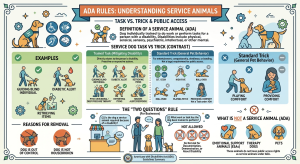
Because many disabilities remain invisible, business owners often wonder how to verify that a service animal is legitimate. Under the Department of Justice’s official ADA guidelines, staff may only ask two specific questions:
-
Is the dog a service animal required because of a disability?
-
What work or task has the dog been trained to perform?
Note that the second question specifically targets the task. If the handler describes a trick (“He knows how to shake hands”) or a natural behavior (“He calms me down”), the dog does not meet the legal requirement.
Comparing Real-World Scenarios: Dog Task vs Trick Examples
To make the reality of a dog task vs trick completely clear, let’s compare a few similar-looking actions:
-
The Trick: You throw a tennis ball, and your dog retrieves it as a game.
-
The Task: A handler drops their keys, and the service animal retrieves them to place them in the handler’s hand.
-
The Trick: Your dog “speaks” or barks on command to earn a biscuit.
-
The Task: A hearing dog barks to alert a deaf handler to a sounding fire alarm.
Why Distinguishing the Dog Task vs Trick Matters for Public Access
This distinction carries heavy weight for a reason. First, misrepresenting a pet as a service dog directly harms disabled individuals. When businesses encounter “fake” service dogs that misbehave, they often become wary, leading to increased harassment of legitimate handlers.
Furthermore, an untrained pet in a public space poses a physical threat to real working dogs. Because service dogs require years of expensive training, a single attack by a dog can force a handler to retire their life-saving animal prematurely.
Conclusion: Summarizing the Dog Task vs Trick Distinction
In conclusion, while we enjoy tricks for fun, we rely on tasks to save lives. The difference in a dog task vs trick marks the dividing line between entertainment and vital medical assistance.
Service dogs act as highly specialized working professionals. By understanding the legal definitions and recognizing these functional differences—as supported by groups like Assistance Dogs International—we can foster a more inclusive society for disabled individuals and their incredible canine partners.